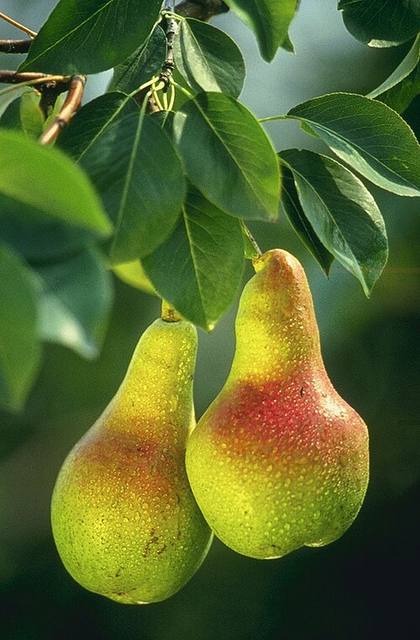
Photo: Keith Weller · Public domain · Wikimedia Commons

Pear
Pyrus communis
Also called Common pear, European pear
Tree · Family Rosaceae · Native to Europe and western Asia
A long-lived, upright fruit tree with white spring blossom and sweet, juicy fruit in autumn. It is hardy but blossoms early, so shelter and a partner tree help.
Not on the ASPCA's list: keep it out of reach of pets.
Care
Light
Full sun
Needs full sun and shelter, especially from late frost. Shade gives poor blossom and small fruit.
Water
About every 14 days in the growing season, every 28 in the cool season
Water young trees weekly in dry weather and keep a mulch ring. Established trees mostly cope, but dry spells while fruit swell cause drop and small pears. Winter days are for the dormant tree.
Water when the top 5 cm (2 in) of soil is dry
Humidity
Medium humidity
Outdoor air is fine. Wet spring weather increases scab and blossom wilt.
Temperature
10 to 28 °C (50 to 82 °F)
Hardy to about -25 °C (-13 °F) when dormant; blossom dies below about -2 °C (28 °F). Grows best at 10 to 28 °C (50 to 82 °F). It needs winter chill.
Soil
Fertile, moisture-retentive but well-drained loam, pH 6 to 7. It tolerates heavier soil than apples do, but not waterlogging.
Feeding
Mulch with compost each spring and feed with a balanced fertiliser in early spring. Do not overfeed; too much nitrogen causes fire blight-prone growth.
Repotting
Not repotted in the ground. Potted dwarf trees need a bigger pot every 3 years and renewed topsoil each spring.
Pruning
Prune in winter while dormant: remove dead, crossing and diseased wood and thin crowded spurs. Keep the centre open so air and light get in.
Propagation
Buy a grafted tree on a quince or pear rootstock; seeds do not give the same fruit. Plant a second variety that flowers at the same time.
Size
300 to 800 cm (118 to 315 in)
Medium growth
Outdoors
USDA zones 4 to 9
Hardy tree for a sunny, sheltered garden; trained forms suit walls. Dwarf trees need 3 to 4 m (10 to 13 ft); full trees much more.
Eating
Ripe fruit
Pick when it lifts from the spur and ripen indoors, since pears ripen from the inside out. The core and seeds are not eaten.
Common problems
Black scabs on leaves and fruit
Pear scab
Rake up and bin fallen leaves, prune for air flow and choose resistant varieties.
Blossom turns brown and shrivels
Frost or fire blight
Cover blossom on frosty nights; cut out blackened shoots well below the damage.
Pears gritty and hard to ripen
Picked too late or too early
Pick when the stalk lifts and ripen indoors.
Orange spots on leaves
Pear rust (from junipers)
Remove affected leaves and avoid planting near juniper.
Few fruit
Not enough pollination
Plant a second variety that flowers at the same time.
Did you know?
Pears ripen best off the tree: picked firm and left a week or two indoors, they are sweeter and less gritty than tree-ripened fruit.
General care information for a typical plant. Conditions in your home or garden may need a different rhythm.
Not sure what your plant is?
Identify a plant from a photoSee this guide in the appKagn Plants also keeps your own plants with watering reminders, and its plant doctor reads what is wrong with one.
Updated 22 November 2026.