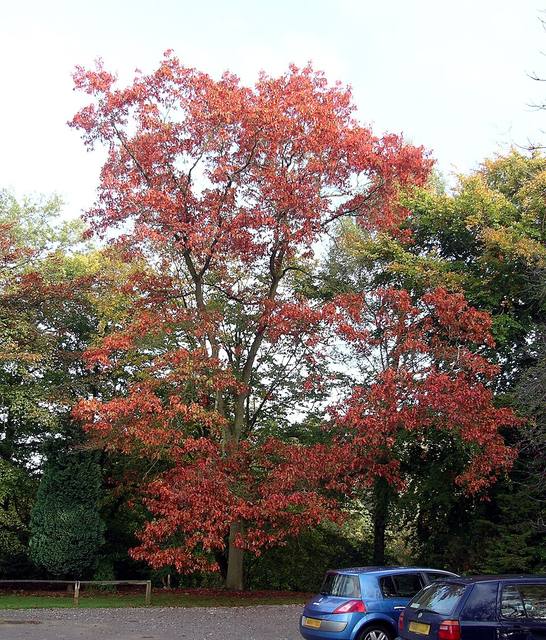
Photo: Velela (assumed by Wikimedia Commons) · Public domain · Wikimedia Commons

Northern red oak
Quercus rubra
Also called Red oak, Champion oak
Tree · Family Fagaceae · Native to Eastern North America
A fast, large oak with pointed, bristle-tipped leaves that turn red in autumn. It tolerates city conditions better than most oaks and grows faster than white oaks.
Not on the ASPCA's list: keep it out of reach of pets.
Care
Light
Full sun
Needs full sun. In shade it is thin and leggy.
Water
About every 14 days in the growing season, every 30 in the cool season
Water new trees deeply every week or two for 2 or 3 years. Established trees tolerate drought. Dormant in winter, so only water in a very dry spell.
Water young trees every 7 to 14 days in dry weather
Humidity
Medium humidity
Outdoor humidity is no concern.
Temperature
8 to 28 °C (46 to 82 °F)
Hardy to about -35 °C (-31 °F). Grows best at 8 to 28 °C (46 to 82 °F). The leaves fall in autumn.
Soil
Acid to neutral, moist, well-drained soil. It develops yellow leaves on chalk or very alkaline soil and dislikes waterlogging.
Feeding
Do not feed. Mulch in autumn with leaf mould, kept off the trunk.
Repotting
Plant it small in the ground. Oaks resent root disturbance.
Pruning
Prune only in winter. Remove dead, crossing or weak branches while it is young. Do not prune in spring and summer, which spreads oak diseases.
Propagation
Sow fresh acorns in autumn. Acorns take two years to mature. Protect seedlings from squirrels and deer.
Size
2500 to 3500 cm (984 to 1378 in)
Fast growing
Outdoors
USDA zones 3 to 8
Needs 12 to 15 m (40 to 50 ft) width. Keep it away from buildings and drains. Best as a park or large-garden tree.
Common problems
Leaves yellow with dark veins
Alkaline soil (iron chlorosis)
Check the pH. Mulch with acid compost, or plant a different oak in chalk.
Leaves wilt and fall in summer
Oak wilt fungus (North America) or drought
Do not prune in spring and summer. Water in drought and ask an arborist if branches die.
Chewed leaves
Caterpillars of gypsy moth or oak leaf rollers
A healthy tree recovers. Use a trunk band on young trees.
Bumps and galls on leaves
Gall wasps
Harmless. Leave them.
Hole-filled bark
Borers in stressed trees
Water deeply in drought, keep soil level and avoid trunk damage.
Did you know?
Red oak acorns take two growing seasons to ripen, whereas white oak acorns ripen in one. Red oak acorns are very bitter with tannins.
General care information for a typical plant. Conditions in your home or garden may need a different rhythm.
Not sure what your plant is?
Identify a plant from a photoSee this guide in the appKagn Plants also keeps your own plants with watering reminders, and its plant doctor reads what is wrong with one.
Updated 22 November 2026.