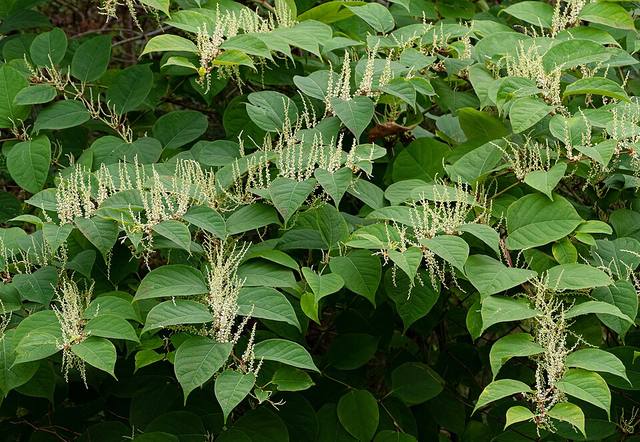
Photo: W.carter · CC0 · Wikimedia Commons

Japanese knotweed
Reynoutria japonica
Also called Fleeceflower, Mexican bamboo, Donkey rhubarb
Lawn weed · Family Polygonaceae · Native to Japan, China, Korea; invasive elsewhere
A tall, hollow-stemmed plant that makes dense stands and spreads by strong roots. It is a serious invasive weed, and in many places the law says you must not let it spread or move soil that contains it.
Not on the ASPCA's list: keep it out of reach of pets.
Care
Light
Full sun
Grows in sun or part shade, and spreads fastest in open, sunny ground along rivers, roads and railway lines.
Water
About every 14 days in the growing season, every 28 in the cool season
It needs no help and withstands drought once established, because its roots reach deep. The question for finders is how to remove it, not how to water.
Not needed: it grows on rain in most soils
Humidity
Medium humidity
Normal outdoor humidity is fine.
Temperature
12 to 28 °C (54 to 82 °F)
Grows best at 12 to 28 °C (54 to 82 °F). Frost kills the leaves in autumn, but roots survive to about -25 °C (-13 °F) and shoot up again in spring.
Soil
It grows in almost any soil, from sand to clay, and in rubble and wet river banks. Poor ground does not slow it much.
Feeding
Do not feed it. It grows well without help. Never spread cuttings or soil from near it, because pieces regrow.
Repotting
Nothing to repot. Pieces of root as small as a fingernail can regrow, so soil from an infested spot must not be moved or composted.
Pruning
Do not cut it and leave the cuttings, and do not compost or mow it into the lawn. In many countries removal is a regulated job. Check your local rules before you dig or move soil.
Propagation
It spreads by root pieces and cut stems in moved soil and green waste. Do not plant it. If it grows on your land, deal with it as an invasive weed and follow local rules.
Size
150 to 300 cm (59 to 118 in)
Fast growing
Outdoors
USDA zones 4 to 9
Found along rivers, roads and in gardens in Europe and North America. It breaks paving and walls. Spreading it is an offence in many countries.
Eating
Young spring shoots
Only from land free of other pollution or weedkiller. Do not take cuttings away or spread it. Not advice to harvest it; removal is the aim.
Common problems
Bamboo-like canes with red specks and shield leaves
Japanese knotweed
Do not cut or dig it yet. Take photos and check your local rules. Many places require a plan to treat it.
It shoots up through paving or a wall
Strong roots forcing a gap
Get local advice on removal. Do not dig it out in a hurry, because spreading pieces make it worse.
It came back after cutting
Roots alive under the ground
Cutting alone does not kill it. Repeated treatment over several years is normal.
A new patch appears elsewhere
Root pieces moved with soil
Do not move soil from near knotweed. Dispose of it only as the local rules say.
Not sure it is knotweed
Look-alikes such as dogwood or bindweed
Check for zig-zag stems, red speckles, hollow canes and shield-shaped leaves with a flat base.
Did you know?
A single piece of rhizome weighing less than a gram can grow into a new plant, and it can push through tarmac, which is why moving soil from infested sites is regulated.
General care information for a typical plant. Conditions in your home or garden may need a different rhythm.
Not sure what your plant is?
Identify a plant from a photoSee this guide in the appKagn Plants also keeps your own plants with watering reminders, and its plant doctor reads what is wrong with one.
Updated 22 November 2026.