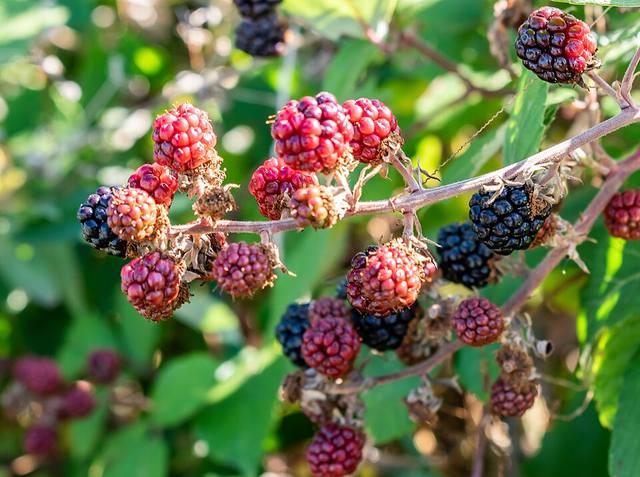
Photo: Tournasol7 · CC BY 4.0 · Wikimedia Commons

Blackberry
Rubus fruticosus
Also called Bramble, Brambles
Shrub · Family Rosaceae · Native to Europe and western Asia
A thorny, arching shrub that roots where its stem tips touch the ground. It gives sweet black fruit in late summer and also overruns hedgerows and gardens.
Not on the ASPCA's list: keep it out of reach of pets.
Care
Light
Full sun
Fruits best in full sun but grows in part shade, where it gives less fruit. Wild plants in deep shade are thin and rarely fruit.
Water
About every 14 days in the growing season, every 21 in the cool season
Established plants rarely need water. Water a young plant weekly for the first season, and soak established plants every 2 weeks in a dry spell while fruit swells. Dry weather gives small, hard fruits.
Water when the soil 10 cm (4 in) down is dry
Humidity
Medium humidity
Outdoor air is fine. It takes damp and dry spells.
Temperature
5 to 28 °C (41 to 82 °F)
Fully hardy to about -20 °C (-4 °F). New canes grow best at 5 to 28 °C (41 to 82 °F). Late frost can damage the flowers.
Soil
Any reasonably fertile soil that drains. It tolerates poor ground and clay. It likes pH 5.5 to 7 and grows even on rough ground.
Feeding
Needs no regular feeding. A spring mulch of compost is enough for a cultivated plant.
Repotting
Not potted. Divide or move suckers in late winter, or leave it in place. A mature clump lives for many years.
Pruning
After fruiting, cut out the canes that fruited down to the ground. Tie in the new canes. Wear thick gloves and long sleeves: the thorns are sharp.
Propagation
Bend a cane tip to the soil in summer and bury it. It roots in weeks (tip layering). Cut it free in autumn.
Size
100 to 300 cm (39 to 118 in)
Fast growing
Outdoors
USDA zones 5 to 9
Grows on hedgerows and rough ground. Give a garden plant a support wire and 1.5 to 2 m (5 to 6.5 ft). To remove brambles, dig out the crown.
Eating
Ripe berries
Pick fruit away from roads and sprayed verges and wash it. The thorny stems and leaves are not eaten.
Common problems
Canes everywhere, spreading across the plot
Tip layering and suckers
Cut canes to the ground, dig out the crown and any tip that has rooted. Cut it back every summer.
Small, dry, crumbly fruit
Drought while the fruit swells, or poor pollination
Water well during fruiting. Plant where bees can reach the flowers.
Orange powdery pustules under leaves
Rust fungus
Cut out and bin the affected canes. Space canes so air gets through.
Lots of leaves but little fruit
Too much shade or too much nitrogen
Cut back nearby plants for light. Do not feed in summer.
Cuts and scratches while picking
Thorns
Wear thick gloves. Thornless garden types exist.
Did you know?
It is really a group of hundreds of near-identical micro-species that reproduce without pollination, so every area has its own local kind of bramble.
General care information for a typical plant. Conditions in your home or garden may need a different rhythm.
Not sure what your plant is?
Identify a plant from a photoSee this guide in the appKagn Plants also keeps your own plants with watering reminders, and its plant doctor reads what is wrong with one.
Updated 22 November 2026.