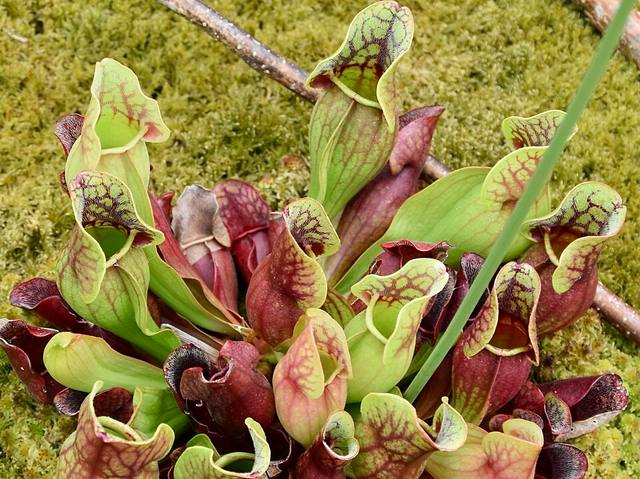
Photo: NasserHalaweh · CC BY-SA 4.0 · Wikimedia Commons

Purple pitcher plant
Sarracenia purpurea
Also called Northern pitcher plant, Pitcher plant, Side-saddle flower
Houseplant · Family Sarraceniaceae · Native to Eastern North America
A hardy bog plant with green and purple pitchers that fill with rain and trap insects. It lives outdoors in cold climates and is a favourite carnivorous plant.
Not on the ASPCA's list: keep it out of reach of pets.
Care
Light
Full sun
Needs full sun, at least 6 hours a day. In shade the pitchers go pale and stay small. A windowsill indoors is usually too dim, so grow it outside in summer.
Water
About every 3 days in the growing season, every 14 in the cool season
Stand the pot in a saucer of rainwater or distilled water. Tap water has minerals that build up and kill it. In winter dormancy the mix should just stay damp, so water much less.
Keep the pot standing in 2 cm (1 in) of rainwater at all times in summer
Humidity
Medium humidity
Ordinary outdoor humidity is fine. It does best in open air and not in a closed, steamy terrarium.
Temperature
10 to 30 °C (50 to 86 °F)
Grows best at 10 to 30 °C (50 to 86 °F). It is fully hardy to about -30 °C (-22 °F) and needs a cold winter rest of about 3 months.
Soil
Poor, acid peat mixed with sand or perlite, about half and half. No compost, no fertiliser, which would burn the roots.
Feeding
Do not feed it. It catches its own food. If you like, drop a small insect into a pitcher now and then. Fertiliser kills it.
Repotting
Every 2 years
Repot or divide every 2 to 3 years in early spring, before growth starts, in fresh peat and sand.
Pruning
Cut off pitchers that turn brown and dry in autumn. Never cut green ones.
Propagation
Divide a clump in early spring when it has several growing points, keeping roots on each piece. Or sow fresh seed on damp peat and chill it first for several weeks.
Size
20 to 40 cm (8 to 16 in)
Slow growing
Outdoors
USDA zones 3 to 9
Grows in cold climates in a sunny bog or a pot in a tray of rainwater. It needs a cold winter. In winter it dies back and returns in spring.
Common problems
Pitchers turn brown in autumn
Normal winter dormancy
Cut off dead pitchers. Keep the mix damp and leave the plant in the cold.
Pitchers small and pale
Too little light
Move it to full sun for at least 6 hours.
Leaf tips brown and crusty
Tap water minerals
Use rainwater or distilled water only. Flush the pot.
Few new pitchers after winter
No winter rest
Give it 3 months of cold, below 10 °C (50 °F), the following winter.
Aphids or scale on pitchers
Pests
Rinse off with water, or wipe them off.
Did you know?
It is the floral emblem of Newfoundland and Labrador. Its pitchers hold rainwater, and a small community of insect larvae and microbes lives in the water.
General care information for a typical plant. Conditions in your home or garden may need a different rhythm.
Not sure what your plant is?
Identify a plant from a photoSee this guide in the appKagn Plants also keeps your own plants with watering reminders, and its plant doctor reads what is wrong with one.
Updated 22 November 2026.