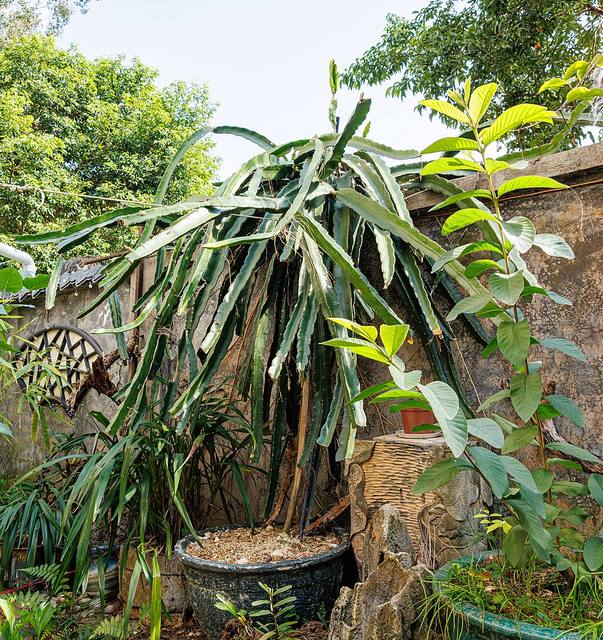
Photo: Dinkun Chen · CC BY-SA 4.0 · Wikimedia Commons

Dragon fruit
Selenicereus undatus
Also called Pitaya, Pitahaya, Night-blooming cereus, Queen of the night
Succulent or cactus · Family Cactaceae · Native to Mexico, Central America and Colombia
A climbing cactus with long, three-ribbed, sprawling stems that grows up a post or trellis. It makes huge white night flowers and pink fruit with speckled flesh.
The ASPCA lists this plant as non-toxic to cats and dogs
Care
Light
Full sun
Give it full sun, at least 6 hours, with light shade in strong summer heat. In low light it will not flower. It needs a post or trellis to climb.
Water
About every 7 days in the growing season, every 21 in the cool season
Water deeply, then let the top dry. It stores water in its stems but likes more water than a desert cactus. Water far less in winter. Wet cold soil rots roots.
Water when the top 5 cm (2 in) of mix is dry
Humidity
Medium humidity
Normal humidity is fine.
Temperature
18 to 35 °C (64 to 95 °F)
Grows best at 18 to 35 °C (64 to 95 °F). Damage starts below 5 °C (41 °F), and frost kills it.
Soil
A free-draining mix of cactus compost with extra grit and some organic matter. Use a large pot with a strong post.
Feeding
Every 4 weeks in the growing season
Feed every 4 weeks in spring and summer with a balanced feed. Use less in winter.
Repotting
Every 2 years
Repot every 2 years in spring, one size up, as the plant grows fast.
Pruning
Tie new stems to the support. Cut back stems that droop after flowering, to keep the shape. Wear gloves.
Propagation
Cut a 30 cm (12 in) section, let the cut end dry for 4 to 7 days and set it in gritty mix. It roots in a few weeks.
Size
150 to 400 cm (59 to 157 in)
Fast growing
Outdoors
USDA zones 10 to 11
Grows outdoors in frost-free gardens on a post or wall in full sun. It flowers in summer.
Eating
Ripe fruit flesh
Stems have spines, so wear gloves when handling.
Common problems
Soft, yellow stem
Overwatering or cold
Water less, make sure the pot drains and keep it above 5 °C (41 °F).
Long, thin stems and no flowers
Too little light
Move it to full sun and let it climb a support.
Flower buds drop
Sudden change or dry spell
Keep light and watering steady while in bud.
Flowers but no fruit
No pollination
Dab pollen from one flower onto another at night, or grow a second plant.
Scars or brown patches
Sunburn
Move to light shade in hot midday sun.
Did you know?
Each white flower opens for one night only and can be 30 cm (12 in) wide. The fruit has no real taste until fully ripe.
General care information for a typical plant. Conditions in your home or garden may need a different rhythm.
Not sure what your plant is?
Identify a plant from a photoSee this guide in the appKagn Plants also keeps your own plants with watering reminders, and its plant doctor reads what is wrong with one.
Updated 22 November 2026.