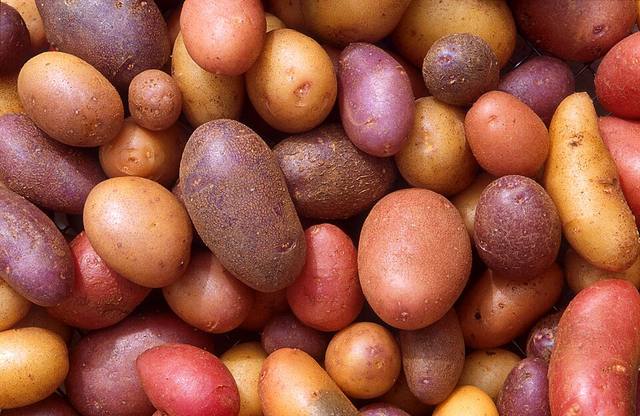
Photo: Scott Bauer, USDA ARS · Public domain · Wikimedia Commons

Potato
Solanum tuberosum
Also called Garden potato, Spud
Vegetable · Family Solanaceae · Native to Andes of Peru and Bolivia
A starchy tuber crop grown from seed potatoes. It is easy in a bed or a deep bag, and gives a harvest 10 to 20 weeks after planting.
Toxic to cats and dogs
Toxic principle: Solanine, saponins, atropine like substances
Signs: Hypersalivation, inappetence, severe gastrointestinal upset, diarrhea, drowsiness, CNS depression, confusion, behavioral change, weakness, dilated pupils, slow heart rate
Care
Light
Full sun
Full sun, at least 6 hours. In shade the plant grows tall and weak, with a small yield.
Water
About every 5 days
Water deeply, especially while tubers form after flowering. Uneven watering makes cracked or hollow tubers. A summer crop that dies back in autumn, so the winter figure equals the summer one.
Water when the top 5 cm (2 in) of soil is dry
Humidity
Medium humidity
Ordinary outdoor humidity. Warm, humid, wet weather encourages blight.
Temperature
10 to 25 °C (50 to 77 °F)
Best at 10 to 25 °C (50 to 77 °F). Frost kills the leaves, and tubers stop forming above about 27 °C (81 °F).
Soil
Loose, rich, well-drained soil, pH 5.0 to 6.5. Heavy clay makes small, misshapen tubers. In bags use 30 litres or more.
Feeding
Every 3 weeks in the growing season
Feed with a balanced fertiliser at planting, and a high-potash feed every 3 weeks until flowering. Too much nitrogen gives leaves, few tubers.
Repotting
Annual: plant a new seed potato each spring, and rotate the bed each year (3 to 4 years apart) to avoid disease.
Pruning
Earth up soil around the stems when 20 cm (8 in) tall, so tubers do not turn green in the light. Do not cut leaves until they die back.
Propagation
Plant a sprouted seed potato 10 to 15 cm (4 to 6 in) deep in spring, 30 cm (12 in) apart. Use certified seed, not shop potatoes, which may carry disease.
Size
40 to 100 cm (16 to 39 in)
Fast growing
Outdoors
USDA zones 3 to 10
Grown as a summer crop in the ground or in deep bags, in full sun, with rows 60 to 75 cm (24 to 30 in) apart. Plant after the worst frosts.
Eating
The tuber, cooked
The leaves, stems, berries and any green or sprouting tubers are poisonous; do not eat them.
Common problems
Brown leaves, white mould underneath
Potato blight
Remove and bin affected leaves. In a wet spell, lift the crop early.
Green tubers
Light reaching them
Earth up the plants or mulch; do not eat green skin.
Scabby, rough skin
Scab, dry soil
Keep the soil evenly moist when tubers form.
Chewed leaves, orange larvae
Colorado beetles
Hand-pick beetles and larvae, and rotate the crop.
Plants fail to sprout
Cold, wet soil
Plant after the soil warms above about 8 °C (46 °F).
Did you know?
A potato is a swollen underground stem, not a root. Light turns it green by making chlorophyll, and the same light also makes more of the poisonous solanine.
General care information for a typical plant. Conditions in your home or garden may need a different rhythm.
Not sure what your plant is?
Identify a plant from a photoSee this guide in the appKagn Plants also keeps your own plants with watering reminders, and its plant doctor reads what is wrong with one.
Updated 22 November 2026.