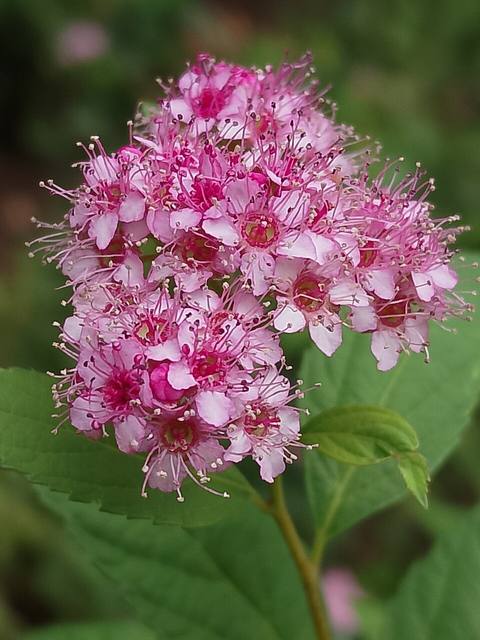
Photo: TheNoob1337 · CC BY-SA 4.0 · Wikimedia Commons

Japanese spiraea
Spiraea japonica
Also called Japanese meadowsweet, Spirea, Spiraea
Shrub · Family Rosaceae · Native to Japan and China
A compact, tough, summer-flowering shrub with flat pink flower heads and often colourful new leaves. It is very easy and good for borders and low hedges.
Not on the ASPCA's list: keep it out of reach of pets.
Care
Light
Full sun
Best in full sun, which gives the most flowers and best foliage colour. It tolerates part shade. Weak, thin growth means not enough light.
Water
About every 10 days in the growing season, every 21 in the cool season
Water new plants weekly in dry spells. Established shrubs only need water in long droughts. It tolerates dry spells better than wet soil.
Water when the top 4 cm (1.5 in) of soil is dry
Humidity
Medium humidity
Outdoor air is fine.
Temperature
10 to 28 °C (50 to 82 °F)
Hardy to about -30 °C (-22 °F) when dormant. Grows best at 10 to 28 °C (50 to 82 °F). Late frost may nip new foliage but it recovers.
Soil
Average, well-drained soil, pH 5.5 to 7.5. It tolerates most soils but not waterlogging.
Feeding
Little feeding is needed. A scatter of balanced slow-release fertiliser in early spring is enough on poor soil.
Repotting
Not repotted in the ground. Divide old clumps in early spring if you want more plants.
Pruning
Prune in late winter or early spring; it flowers on new wood. Cut stems back by half to a third, or to 15 cm (6 in) for a tidy, compact shape. Deadhead to extend flowering.
Propagation
Take softwood cuttings in early summer, or divide the clump in spring or autumn.
Size
60 to 120 cm (24 to 47 in)
Fast growing
Outdoors
USDA zones 3 to 8
Hardy shrub for a sunny bed or low hedge, 60 to 90 cm (2 to 3 ft) apart. Little work is needed. Colourful new leaves appear in spring.
Common problems
Few flowers
Too much shade or no pruning
Give sun and prune in late winter.
Brown leaf tips
Drought or heat
Water in dry spells and mulch.
Aphids on new growth
Aphids
Wash off with a hose.
Dieback of shoots
Frost or fireblight
Cut out dead stems to healthy wood.
Spreads by seeding or suckers
Natural habit
Dig out unwanted seedlings; in some regions it is invasive, so check local advice.
Did you know?
Japanese spiraea is invasive in parts of the eastern United States, where birds spread its seed into woods and stream banks.
General care information for a typical plant. Conditions in your home or garden may need a different rhythm.
Not sure what your plant is?
Identify a plant from a photoSee this guide in the appKagn Plants also keeps your own plants with watering reminders, and its plant doctor reads what is wrong with one.
Updated 22 November 2026.