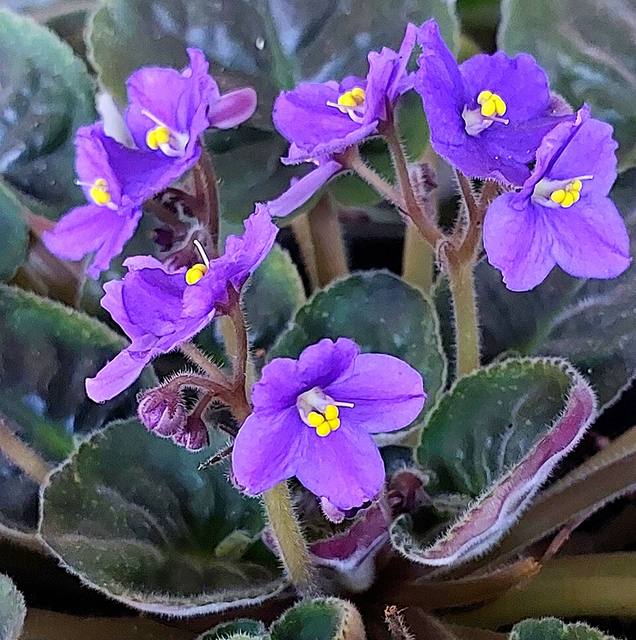
Photo: Chandralekha CT · CC BY-SA 4.0 · Wikimedia Commons

African violet
Streptocarpus ionanthus
Also called Saintpaulia, Usambara violet
Houseplant · Family Gesneriaceae · Native to Tanzania and Kenya (eastern mountains)
A small rosette of soft, hairy leaves that flowers in violet, pink or white nearly all year indoors. It is a classic windowsill plant that likes steady care.
The ASPCA lists this plant as non-toxic to cats and dogs
Care
Light
Bright, indirect light
Bright, filtered light all year, such as an east window or a spot back from a south one. Dark green, stretched leaves with no flowers mean too little light. Direct sun leaves pale scorch spots.
Water
About every 7 days in the growing season, every 10 in the cool season
Use room-temperature water and keep it off the leaves, where it leaves marks. Water from below or at the soil edge. Soggy soil rots the crown and roots. Cold water spots leaves.
Water when the top 1 cm (0.5 in) of soil feels dry
Humidity
Medium humidity
Normal home air is fine, though around 50 % suits it best. Set it on a tray of damp pebbles. Do not mist, as water spots the hairy leaves.
Temperature
18 to 26 °C (64 to 79 °F)
Grows at 18 to 26 °C (64 to 79 °F). It is damaged below about 10 °C (50 °F) and stops flowering when cold or draughty.
Soil
A light, airy, peaty mix made for African violets, with perlite. Use a small, shallow pot with drainage holes.
Feeding
Every 4 weeks in the growing season
Feed every 4 weeks with a feed made for African violets at half strength. Fresh feed in every other watering works too.
Repotting
Every 1 year
Repot every year or so, into fresh mix in the same size pot or just one up. It flowers best in a small pot. Bury the neck of a leggy plant.
Pruning
Pinch off dead flowers and old, tired bottom leaves at the stem. Keep it to a single crown, or divide it.
Propagation
Cut a healthy leaf with a 4 cm (1.5 in) stalk and push the stalk into damp mix. Plantlets form in 4 to 8 weeks.
Size
10 to 25 cm (4 to 10 in)
Slow growing
Outdoors
Not grown outdoors. It is kept as an indoor plant in cool climates.
Common problems
Leaves with no flowers
Not enough light
Move to a brighter window, out of direct sun. Give 12 hours of light a day.
Pale ring spots on leaves
Cold water or droplets on the leaves in sun
Use room-temperature water and keep it off the leaves.
Soft, mushy crown and floppy leaves
Overwatering or crown rot
Let the soil dry, remove rotten leaves, and repot in fresh mix. A badly rotted plant is hard to save.
White powdery coating
Powdery mildew from stuffy air
Improve airflow and remove the affected leaves.
Curled, stunted new leaves
Cyclamen mites or cold
Isolate it. Raise warmth. Heavy infestations are hard to cure, so replace it.
Did you know?
African violets are not true violets. They were first collected in 1892 in what is now Tanzania, by Baron Walter von Saint Paul, and are now one of the world's best-selling houseplants.
General care information for a typical plant. Conditions in your home or garden may need a different rhythm.
Not sure what your plant is?
Identify a plant from a photoSee this guide in the appKagn Plants also keeps your own plants with watering reminders, and its plant doctor reads what is wrong with one.
Updated 22 November 2026.