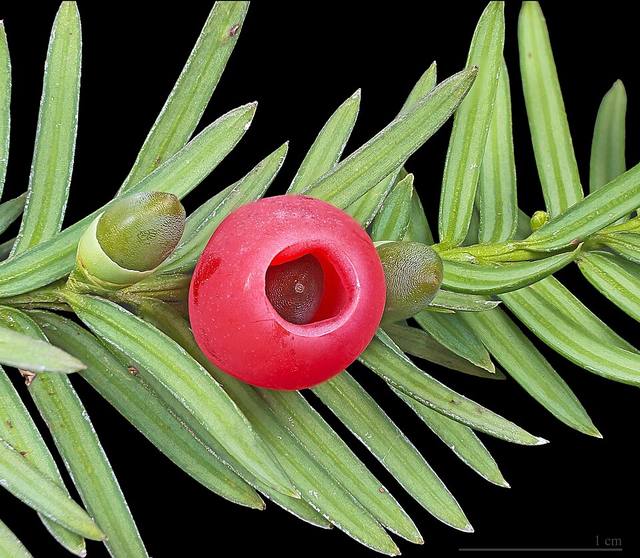
Photo: Didier Descouens · CC BY-SA 4.0 · Wikimedia Commons

English yew
Taxus baccata
Also called Common yew, European yew, Yew
Tree · Family Taxaceae · Native to Europe, North Africa and southwest Asia
A dense, dark evergreen conifer used for hedges and topiary. Slow-growing and very long-lived, with red berry-like cups. All parts except the red flesh are poisonous.
Toxic to cats and dogs
Toxic principle: Taxine A and B, volatile oil
Signs: Tremors, difficulty breathing, vomiting, seizures (dogs), sudden death from acute heart failure
Care
Light
Part sun
Grows in full sun or deep shade, one of few conifers that does. Good for dark corners.
Water
About every 14 days in the growing season, every 30 in the cool season
Water new plants weekly in dry weather for 2 years. Established plants tolerate drought. Evergreen, so water new plants occasionally in a dry winter. Waterlogging kills it.
Water new plants every 7 to 10 days in dry weather
Humidity
Medium humidity
Outdoor humidity is no concern.
Temperature
5 to 25 °C (41 to 77 °F)
Hardy to about -30 °C (-22 °F). Grows best at 5 to 25 °C (41 to 77 °F). Cold winter wind burns foliage in exposed places.
Soil
Any well-drained soil, including chalk and shade. It cannot stand waterlogged or very wet clay.
Feeding
Feed hedges once in spring with a balanced slow-release feed. Mulch with compost.
Repotting
Plant in the ground. A small plant can live in a tub for some years.
Pruning
Clip hedges once a year in late summer. Unlike most conifers, it regrows from old wood, so it can be cut hard in spring. Wear gloves, since sap irritates skin.
Propagation
Slow. Take 10 cm (4 in) semi-ripe cuttings in autumn. Seeds take 18 months to germinate and need cold.
Size
200 to 2000 cm (79 to 787 in)
Slow growing
Outdoors
USDA zones 5 to 7
Plant in sun or shade, 45 to 60 cm (18 to 24 in) apart for hedges. Mature trees spread 6 to 10 m (20 to 33 ft). Keep animals away from the foliage.
Common problems
Yellowing foliage and dying shoots
Waterlogged soil and root rot
Improve drainage or choose a drier place. Do not overwater.
Browning in winter
Cold wind or salt
Shelter exposed hedges and screen from salt spray.
Sticky leaves, sooty mould
Scale insects or aphids
Spray with soapy water or horticultural oil.
Foliage dieback after hard clipping
Cutting too late in autumn
Clip in late summer; hard cuts are best in spring.
Livestock or pets poisoned
Eating clippings or berries
Rake up all clippings and fence animals out. Remove fruiting plants near dogs.
Did you know?
The Fortingall Yew in Scotland is estimated at 2,000 to 3,000 years old, although it is hard to date because yews hollow out as they age.
General care information for a typical plant. Conditions in your home or garden may need a different rhythm.
Not sure what your plant is?
Identify a plant from a photoSee this guide in the appKagn Plants also keeps your own plants with watering reminders, and its plant doctor reads what is wrong with one.
Updated 22 November 2026.