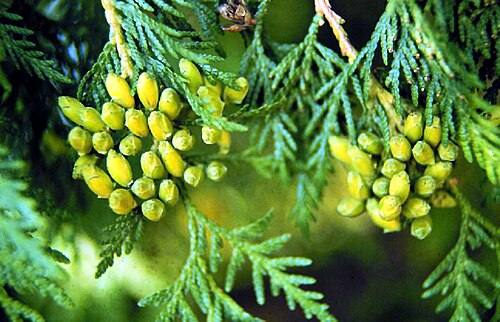
Photo: Unknown author · Public domain · Wikimedia Commons

Eastern white cedar
Thuja occidentalis
Also called Arborvitae, Northern white cedar, Eastern arborvitae
Tree · Family Cupressaceae · Native to Eastern Canada and northeastern United States
A narrow evergreen conifer with flat, scale-like foliage. Dense and upright, it is widely grown as a screen, hedge or foundation planting.
Not on the ASPCA's list: keep it out of reach of pets.
Care
Light
Full sun
Needs full sun to light shade. It thins out and browns inside in deep shade.
Water
About every 7 days in the growing season, every 21 in the cool season
Shallow roots need steady moisture. Water new plants deeply every week for 2 years. Established plants tolerate short dry spells. Evergreen, so water new plants in dry winters.
Water young plants every 5 to 7 days in dry weather
Humidity
Medium humidity
It likes damp air and dislikes hot, dry winds in winter.
Temperature
5 to 25 °C (41 to 77 °F)
Hardy to about -40 °C (-40 °F). Grows best at 5 to 25 °C (41 to 77 °F). Winter wind and sun can burn the foliage brown.
Soil
Moist, well-drained soil, neutral to alkaline. It tolerates wet soil and clay but not drought or compaction.
Feeding
Feed in spring with a balanced slow-release feed for hedges. Skip in late summer.
Repotting
Plant it in the ground or a large tub for dwarf forms. Do not disturb mature plants.
Pruning
Clip lightly in early summer. Never cut back into bare brown wood: it does not regrow from old wood. Trim hedges so the bottom is wider than the top.
Propagation
Hardwood cuttings in late summer root slowly. Most people buy container plants.
Size
200 to 2000 cm (79 to 787 in)
Medium growth
Outdoors
USDA zones 2 to 7
Plant in full sun for a hedge 60 to 90 cm (24 to 36 in) apart. Mature trees 10 to 15 m (33 to 50 ft) tall; many forms are small shrubs.
Common problems
Foliage browns inside and in winter
Normal needle drop in autumn or winter burn
Inner brown is normal. Mulch and shelter young plants from wind.
Tips turn brown in spring
Winter desiccation, dry roots or salt
Water deeply before the ground freezes and screen from wind.
Browning from top down in hot dry summers
Drought or spider mites
Water deeply and spray off mites with water.
Deer eat the plants
Deer browsing in winter
Use fencing or netting for young plants.
Hedge has bare patches
Cut into old wood or shade
Do not cut into bare wood. Plant new shrubs to fill the gap.
Did you know?
The name arborvitae means 'tree of life'. It is said that in 1536 a tea from the leaves, learned from the Iroquois, cured the sailors of Jacques Cartier of scurvy.
General care information for a typical plant. Conditions in your home or garden may need a different rhythm.
Not sure what your plant is?
Identify a plant from a photoSee this guide in the appKagn Plants also keeps your own plants with watering reminders, and its plant doctor reads what is wrong with one.
Updated 22 November 2026.