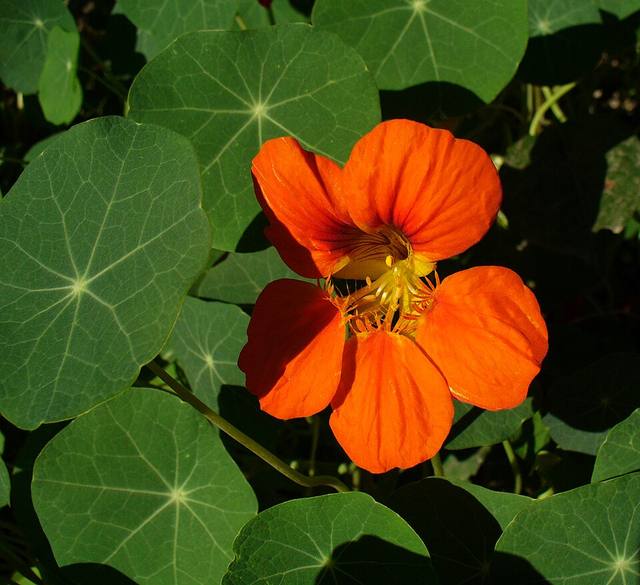
Photo: George Chernilevsky · Public domain · Wikimedia Commons

Nasturtium
Tropaeolum majus
Also called Garden nasturtium, Indian cress, Monk's cress
Garden flower · Family Tropaeolaceae · Native to Andes, Colombia to Bolivia
A fast, easy annual with round leaves and bright orange, red or yellow flowers. The leaves, flowers and seeds are edible with a peppery taste, and it draws aphids from other plants.
The ASPCA lists this plant as non-toxic to cats and dogs
Care
Light
Full sun
Full sun for most flowers. It grows in part shade but gives more leaves and fewer flowers.
Water
About every 7 days
Water once a week in dry weather, less on poor soil. Wet, rich soil gives leaves and no flowers. It is an annual, so winter number is the same.
Water when the top 5 cm (2 in) of soil is dry
Humidity
Low humidity
Outdoor humidity is no concern. It tolerates dry air.
Temperature
12 to 27 °C (54 to 81 °F)
Best at 12 to 27 °C (54 to 81 °F). Frost, below 0 °C (32 °F), kills it. Growth slows in heat above 30 °C (86 °F).
Soil
Poor to average, well-drained soil. Rich soil gives leaves, not flowers. Slightly acid to neutral.
Feeding
Do not feed. Rich soil and feed give leaves and few flowers.
Repotting
Sow each year where it will grow. It does not like root disturbance.
Pruning
Pinch long stems to keep it neat. Cut back if it takes over. Deadhead to extend flowering.
Propagation
Sow the big seeds 2 cm (1 in) deep in spring after frost, or earlier in pots. They germinate in 7 to 10 days.
Size
25 to 300 cm (10 to 118 in)
Fast growing
Outdoors
USDA zones 9 to 11
Grown as an annual in zones 2 to 8 and a short-lived perennial in 9 to 11. Sow where it will flower, 25 to 30 cm (10 to 12 in) apart.
Eating
Leaves, flowers and seed pods
Wash before eating. Pick from plants not sprayed with pesticide. Keep strong flavour in mind.
Common problems
Many leaves, few flowers
Rich soil or too much feed
Stop feeding and water less. It flowers best in poor soil.
Clusters of black aphids
Aphids
Spray off with water. Accept some, as it works as a decoy plant.
Holes in leaves, green caterpillars
Cabbage white butterfly caterpillars
Pick them off. They are visible on the leaves.
Leaves yellow and plant collapses
Wet soil
Plant on poorer, better-drained soil and water less.
Plant sprawls across the bed
Vigorous growth
Pinch the tips and choose a compact variety.
Did you know?
Nasturtium leaves, flowers and young seed pods taste of watercress and can be eaten in salads. The seed pods are pickled as 'poor man's capers'.
General care information for a typical plant. Conditions in your home or garden may need a different rhythm.
Not sure what your plant is?
Identify a plant from a photoSee this guide in the appKagn Plants also keeps your own plants with watering reminders, and its plant doctor reads what is wrong with one.
Updated 22 November 2026.