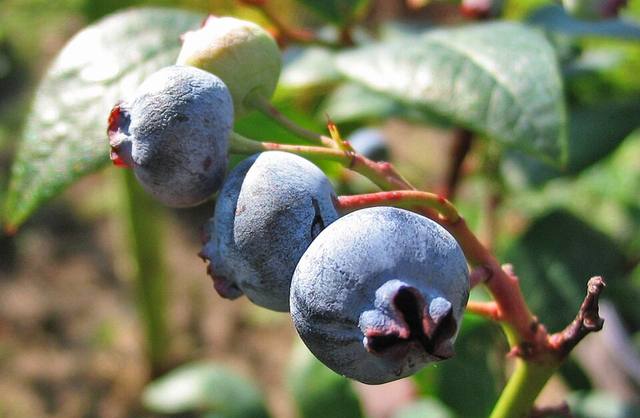
Photo: Darkone (talk · contribs) · CC BY-SA 2.5 · Wikimedia Commons

Highbush blueberry
Vaccinium corymbosum
Also called Blueberry, Northern highbush blueberry
Shrub · Family Ericaceae · Native to Eastern North America
A bushy shrub with white spring flowers, blue berries in summer and red autumn leaves. It must have acid soil and does well in a pot of ericaceous mix.
Not on the ASPCA's list: keep it out of reach of pets.
Care
Light
Full sun
Best in full sun for the most berries; part shade is fine in hot areas. Deep red leaves in autumn are normal. Pale, yellow leaves with green veins mean the soil is not acid enough.
Water
About every 4 days in the growing season, every 10 in the cool season
Keep the soil evenly moist, never soggy or dry. Roots are shallow and fine. Use rainwater, because hard tap water raises the pH. Water more in fruiting.
Water when the top 3 cm (1 in) of soil is dry
Humidity
Medium humidity
Outdoor air is fine. Good air flow helps avoid mould.
Temperature
10 to 26 °C (50 to 79 °F)
Hardy to about -30 °C (-22 °F) when dormant; flowers can be hit by spring frost. Grows best at 10 to 26 °C (50 to 79 °F). It needs winter chill.
Soil
Acid, moist, well-drained, humus-rich soil of pH 4.5 to 5.5. Use ericaceous compost in pots and mulch with pine bark. It will fail in chalk or limy soil.
Feeding
Every 6 weeks in the growing season
Feed every 6 weeks in spring with an ericaceous or acid-loving fertiliser. Avoid fertilisers high in nitrate or lime.
Repotting
Every 3 years
Repot a potted bush every 2 to 3 years in winter, into ericaceous compost and a larger pot. In the ground, nothing needed.
Pruning
Prune in late winter: remove dead wood, weak twigs and the oldest canes, and keep 8 to 10 healthy canes. Remove flowers in year 1 to build the plant.
Propagation
Take softwood cuttings in early summer or buy a named variety. Plant two different varieties to improve the crop through cross-pollination.
Size
100 to 200 cm (39 to 79 in)
Slow growing
Outdoors
USDA zones 4 to 8
Hardy shrub for a sunny, acid, moist bed or large pot; plant 1.2 to 1.5 m (4 to 5 ft) apart. Mulch with pine needles or bark.
Eating
Ripe berries
Eat fresh, cooked or frozen. Leaves and stems are not eaten.
Common problems
Yellow leaves with green veins
Soil too alkaline (iron chlorosis)
Use ericaceous compost, rainwater and an acid feed; check pH.
Few berries
No second variety or poor pollination
Plant a different variety nearby and protect flowers from frost.
Berries eaten
Birds
Net the bush as the berries colour.
Wilting, brown leaves
Drought or waterlogging
Water steadily and mulch; check drainage.
Tip dieback
Frost or fungal blight
Prune out dead stems; protect flowers with fleece on cold nights.
Did you know?
Blueberries need partners: even self-fertile varieties set more and bigger fruit with a second variety nearby, and bumblebees pollinate them by buzzing the flowers.
General care information for a typical plant. Conditions in your home or garden may need a different rhythm.
Not sure what your plant is?
Identify a plant from a photoSee this guide in the appKagn Plants also keeps your own plants with watering reminders, and its plant doctor reads what is wrong with one.
Updated 22 November 2026.